
How to Stop Repeating Yourself as a Manager
You already told them.
Then you told them again.
Then you reminded them.
Then you followed up.
Then you asked yourself the question every tired manager asks sooner or later:
Why do I have to keep repeating myself?
It's one of the most frustrating parts of running people. Not because the task is complicated. Sometimes it's basic. Sometimes it's something the team already knows. Sometimes it's something you've explained so many times you feel ridiculous saying it again.
And somehow, the same issue keeps coming back.
The same mistake. The same missed step. The same forgotten standard. The same late update. The same conversation you thought you already had.
So you repeat yourself.
Again.
But here's the problem.
Repeating yourself isn't a management system.
At some point, another reminder stops being helpful and starts being a warning sign. It means the expectation isn't turning into ownership.
The Real Problem Isn't That You Need to Communicate More
Most advice tells managers to communicate better.
That sounds right. But it's incomplete.
Because you can communicate constantly and still not get follow-through.
You can send reminders. You can hold huddles. You can write recaps. You can repeat the same expectation every week. You can ask, "Does everyone understand?" You can hear "yes" from the whole team.
And still nothing changes.
That's because the issue isn't always communication. Sometimes the issue is transfer.
The message left your mouth, but it never became a clear standard, a doable action, or a real commitment.
That's where managers get stuck. They think the fix is to say it again. But if the original problem wasn't a lack of information, saying the information again won't fix it.
Repeating Yourself Usually Points to One of Three Breakdowns
When you keep repeating yourself, the breakdown is usually in one of three places.
Awareness. Ability. Agreement.
These are the three conditions that have to be true before accountability is fair.
(If the bigger issue is that the work keeps landing back on you, that's a related breakdown. I wrote about it here: You're Doing Your Team's Work. And if your team keeps saying yes and still not delivering, start here: Why Your Team Says Yes But Doesn't Follow Through.)
Awareness
They have to know what good looks like.
Not vaguely. Not generally. Not "they should know by now." Actually know.
Ability
They have to be able to do the work with the skill, time, tools, authority, staffing, and support they've got.
Not theoretically able. Actually able.
Agreement
They have to clearly commit to owning the outcome.
Not nod. Not say "okay." Not stay quiet. Actually agree.
If one of those is missing, you're not dealing with clean accountability yet. You're dealing with a foundation problem. And foundation problems don't get fixed by reminders.
Before You Remind Them Again
Before you repeat the same instruction for the fifth time, stop and diagnose why the reminder's needed in the first place.
Is it Awareness? They still don't clearly understand what good looks like.
Is it Ability? They can't execute consistently with what they have.
Is it Agreement? They never truly committed to owning it.
The fastest way to find the breakdown is the free Accountability Diagnostic: kwanhoward.com/accountability-diagnostic
It takes about 5 minutes and shows you whether your team's follow-through is breaking down in Awareness, Ability, or Agreement.
Because if you misread the breakdown, you fix the wrong problem.
Why Reminders Stop Working
A reminder only works when three things are already true:
The person understands the expectation. The person can do the work. The person agreed to own it.
If all three are true, a reminder can help. Maybe they got busy. Maybe it slipped. Maybe they needed a nudge. Fine.
But if one of those three is missing, a reminder is weak medicine.
If they don't understand the standard, your reminder just repeats confusion.
If they can't execute, your reminder just piles on pressure.
If they never committed, your reminder just chases work they never really owned.
That's why managers feel like they're talking to a wall. They keep using reminders for problems that need diagnosis.
Breakdown 1: They Don't Understand What Good Looks Like
This is the Awareness breakdown.
The manager thinks the expectation's obvious. The team doesn't.
You say:
"Keep the area clean."
They hear:
"Pick up obvious trash when you notice it."
You meant:
"Every 30 minutes, wipe the counters, restock supplies, clear the clutter, check the floor, and make sure it's guest-ready."
Those aren't the same.
You say:
"Send me an update."
They hear:
"Let them know something happened."
You meant:
"Tell me what got done, what's still open, what's blocked, who owns the next step, and when I should expect it resolved."
Again. Not the same.
So you repeat yourself. "Keep it clean." "Send me updates." "Stay on top of it." "Make sure this is handled."
But the problem isn't that they forgot the words. The problem is the standard was never concrete enough to stick.
Awareness warning signs. You might have an Awareness breakdown if you hear:
"I thought you meant..."
"I didn't know you wanted it that way."
"I didn't realize that counted."
"I thought that was good enough."
"Nobody told me that part."
When you hear those, don't jump straight to frustration. First ask yourself: "Did I define what done actually looks like?"
Awareness script: reset the standard
Use this when the person keeps missing the expectation because the standard's fuzzy.
"Let’s reset the standard so we're not running on reminders. Going forward, when I say “this” needs to be done, here's what done means..."
Then define it clearly. For example:
"When I say the closing checklist needs to be complete, I don't mean checked off from memory. I mean every item physically verified, anything incomplete written down, and the handoff message sent before you leave."
That's stronger than another reminder. Now the expectation has shape.
Breakdown 2: They Can't Execute Consistently With What They Have
This is the Ability breakdown.
The person might understand the expectation. They might even want to do it. But something's blocking consistent execution.
Maybe they were never trained right. Maybe they don't have the tools. Maybe they're buried. Maybe they don't have the authority to make the call. Maybe the process is broken. Maybe they can do it when things are calm, but not when the shift gets slammed.
That last one matters.
A lot of managers confuse "they did it once" with "they can do it consistently." Those are different.
Somebody might be able to run the process when you're standing there, staffing's good, and nothing's on fire. But can they do it under pressure? Can they do it when the team's short? When a customer's upset? Without you prompting them?
If not, you might not have an accountability issue yet. You might have an Ability issue.
Ability warning signs. You might have an Ability breakdown if you hear:
"I got busy."
"I didn't have time."
"I was waiting on somebody else."
"I didn't know how to handle that situation."
"I didn't have access."
"We were short."
"I tried, but I got stuck."
Don't take a vague answer at face value, but don't ignore it either. A vague excuse might be hiding a real constraint. Your job is to tell the two apart.
Ability script: find the blocker
Use this when the person's heard the expectation but still can't execute consistently.
"We just covered this expectation Wednesday, so I want to understand what's blocking you. Is this a training thing, a time thing, a tool thing, or a authority and priority thing?"
That question's powerful because it moves the conversation out of emotion and into diagnosis.
If they say "I just got busy," ask: "What specifically took priority over this?"
If they say "I didn't know what to do," ask: "Which part was unclear or outside what you've been trained on?"
If they say "I was waiting on somebody else," ask: "When did you realize you were blocked, and how did you raise it?"
That last one matters. Because even when there's a real blocker, the person still owns the job of raising it early.
Support doesn't mean rescue. Support means you clear the real obstacles while keeping ownership where it belongs.
Breakdown 3: They Never Truly Committed
This is the Agreement breakdown. And it's common.
The team heard you. They understood the task. They might even be able to do it. But there was no real commitment.
There was a nod. There was silence. There was a casual "got it." There was a group conversation where everybody assumed somebody else owned it.
That's not agreement. That's fog. And fog creates follow-up work for the manager.
This is where you end up saying, "I told them this already."
Maybe you did. But telling isn't the same as transferring ownership.
Agreement warning signs. You might have an Agreement breakdown if you hear:
"I thought somebody else had that."
"I didn't know I owned it."
"I thought we were still talking about it."
"I didn't realize it was due today."
"I was going to get to it."
"I didn't think it was that urgent."
This isn't always rebellion. Sometimes it's poor closure. The conversation ended before ownership got nailed down.
Agreement script: close the loop
Use this when work keeps drifting because ownership's unclear.
"I don't want to keep reminding you about this. Are you going to own this going forward? Let's lock the deliverables, the deadline, the first step, and what you do if something blocks you."
That's clean. It doesn't shame anybody. It doesn't turn into a speech. It forces the conversation into ownership.
You want five things clear:
Who owns it. What done looks like. When it's due. What the first step is. When they should raise a blocker.
If those five aren't clear, don't pretend the work's been handed off. It hasn't.
Stop Saying "I Shouldn't Have to Tell You This"
That phrase is understandable. But it usually doesn't help.
Managers say it when they're frustrated because the expectation seems obvious. But to the person, it usually lands as: "You're stupid." "You're careless." "You should've read my mind." "You're already in trouble."
That might not be what you meant. It's often what they hear.
A better version is:
"This expectation must be owned without me repeating it. Let's figure out why that's not happening yet."
That sentence does two things. It keeps the standard clear. And it opens the door to diagnosis. You're not lowering the bar. You're making the conversation useful.
The Reminder Trap
The reminder trap is when you become the system that makes the work happen.
The team doesn't own the routine. The reminder does.
You remind them to send updates. You remind them to finish the checklist. You remind them to follow up. You remind them to prep. You remind them to flag blockers. You remind them to do the thing they already agreed to do.
Eventually the team learns the pattern: "I don't need to track this. The manager will remind me."
That's when reminders become part of the problem. You're not reinforcing ownership anymore. You're replacing it. The more you remind, the less they have to remember.
That doesn't mean never remind anybody. It means reminders shouldn't be the operating system.
What to Do Instead of Repeating Yourself
When the same issue comes back, don't start with the reminder. Start with the pattern.
Say:
"We've talked about this more than once, and it's still showing up. I don't think repeating the same expectation is the right next step. Help me understand what's breaking down."
Then ask:
"Is the standard unclear, is something blocking you, or is the ownership not clear?"
That question maps straight to Awareness, Ability, and Agreement. It keeps you out of the lazy version of accountability where everything turns into "you need to do better."
That phrase rarely fixes anything. Better how? By when? With what support? Against what standard? Owned by whom? If those are unanswered, you'll be repeating yourself again next week.
The Follow-Through Reset Conversation
Here's a simple flow you can run when you're tired of repeating yourself.
Step 1: Name the pattern. "We've talked about this a few times, and it's still not happening consistently."
Step 2: Name the impact. "When this doesn't happen, it creates extra follow-up, it delays the work, and it pulls me back into things you should be owning."
Step 3: Diagnose the breakdown. "Before I treat this as an accountability issue, I want to understand what's breaking down. Is the expectation unclear, is something blocking you, or did we not have a clear commitment?"
Step 4: Reset the expectation. "Going forward, here's what done looks like..."
Step 5: Confirm ownership. "Are you owning this from here?"
Step 6: Set the blocker rule. "If something gets in the way, I expect you to raise it before the deadline, not after I ask."
That's not overcomplicated. That's management.
The Difference Between a Reminder and a Reset
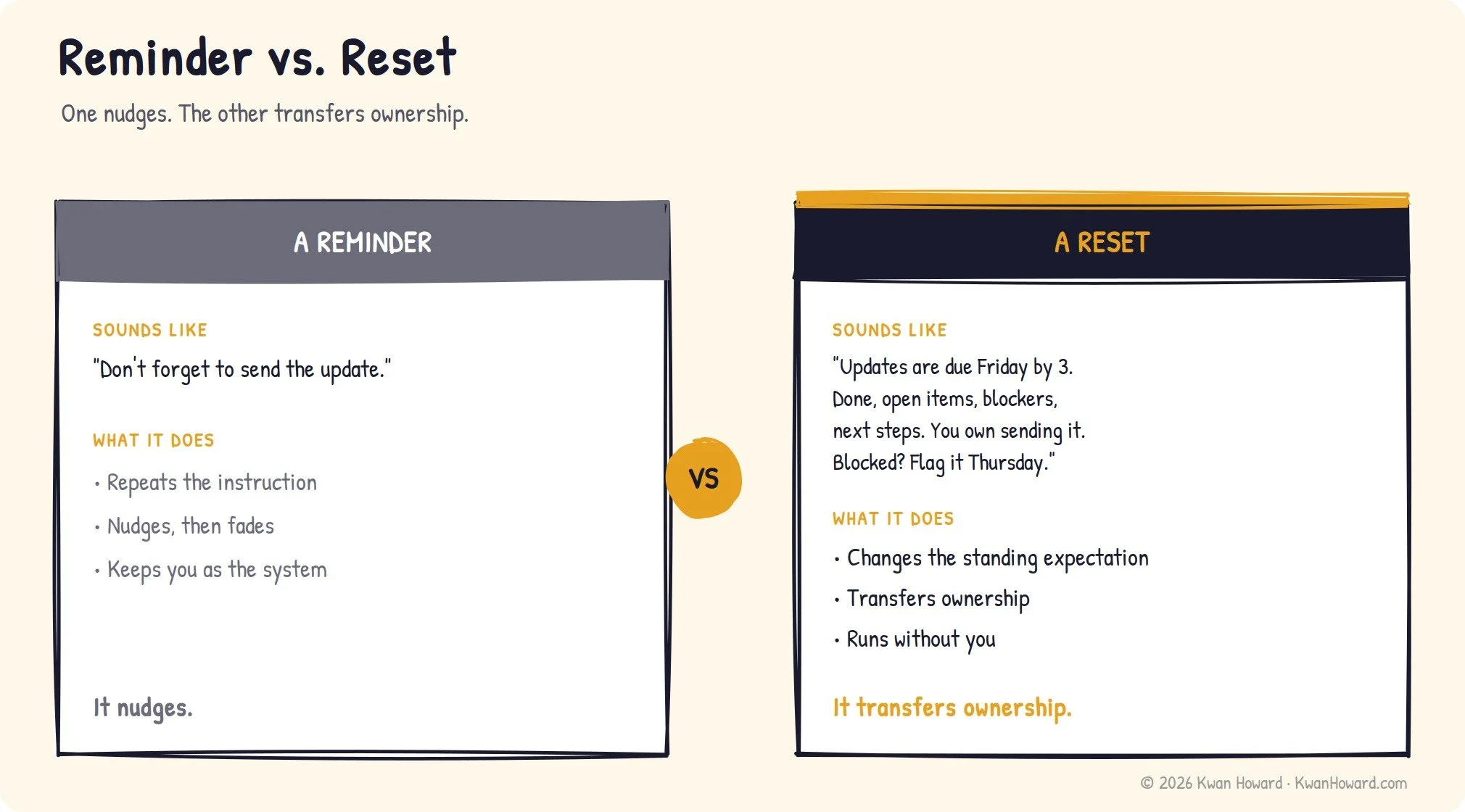
A reminder repeats the instruction. A reset changes the operating expectation.
A reminder says: "Don't forget to send the update."
A reset says: "Going forward, updates are due by 3 p.m. every Friday. They include completed work, open items, blockers, and next steps. You own sending it without me asking. If you're blocked, raise it by Thursday afternoon."
See the difference?
One nudges. The other transfers ownership.
Most managers overuse reminders and underuse resets.
When It Actually Becomes Accountability
At some point, it might become accountability. This matters.
AAA isn't about letting people off the hook. It's about making sure the hook's in the right place.
Once the expectation's clear, the person has the ability, and they've agreed to own the work, the conversation changes. Now you're not diagnosing anymore. Now you're addressing a pattern.
You can say:
"We clarified the expectation. We confirmed you had what you needed. You agreed to own it. The issue's still happening. That's now a follow-through problem, and it needs to change."
That's a much stronger accountability conversation, because you're not arguing about confusion, resources, or unclear ownership. You already handled those. Now the standard's fair.
Diagnose Before You Escalate
If you're getting close to a harder conversation with somebody, slow down long enough to diagnose the breakdown first. Not to dodge accountability. To make the accountability conversation cleaner.
Take the free Accountability Diagnostic: kwanhoward.com/accountability-diagnostic
It'll help you identify whether the issue's Awareness, Ability, or Agreement before you decide what conversation needs to happen next.
A Real-Life Example
Say you run a team, and one person keeps failing to send the daily update.
You've reminded them several times. They apologize. They say it won't happen again. Then it happens again.
The old response is: "How many times do I have to tell you?"
The better response is: "We've talked about the daily update more than once, and it's still not happening consistently. I want to understand what's breaking down."
Then diagnose.
Awareness. "Do you know exactly what needs to be in the update?" Maybe they thought a quick "all good" was enough, but you expected completed tasks, open issues, staffing concerns, and blockers. That's Awareness.
Ability. "Is something stopping you from sending it by the deadline?" Maybe they're always covering the floor at that time and need the deadline moved or the workflow changed. That's Ability.
Agreement. "Did you understand you own sending this every day without me asking?" Maybe they thought it was only needed when something big happened. That's Agreement.
Different breakdowns. Different fixes. Same symptom. That's the whole point.
The symptom is: "They didn't send the update." The diagnosis decides the fix.
Don't Build a Team That Runs on Your Memory
If your team only follows through because you remember to remind them, you don't have ownership. You have execution that only runs when you're standing there.
That's exhausting. It also doesn't scale. The more people you manage, the more reminders you carry. The more reminders you carry, the less time you have for actual leadership.
You become the calendar. You become the checklist. You become the alarm clock. You become the quality-control net. You become the person making sure everybody else remembers what they already agreed to do.
That's not sustainable.
Your job isn't to be the team's memory. Your job is to build standards, systems, and ownership strong enough that the work doesn't run on constant prompting.
Final Thought
If you're tired of repeating yourself as a manager, the answer isn't to say it louder. The answer is to stop and ask why the message isn't turning into ownership.
Is it Awareness? They don't know what good looks like.
Is it Ability? They can't execute consistently with what they have.
Is it Agreement? They never clearly committed to owning it.
Fix the right breakdown. Then accountability finally has something solid to stand on.
Frequently Asked Questions
Why do I have to keep repeating myself as a manager?
You usually keep repeating yourself because the expectation never turned into ownership.
That breakdown is usually one of three things. Awareness: they don't clearly understand what good looks like. Ability: they can't execute consistently with what they have. Agreement: they never clearly committed to owning the outcome.
A reminder might help once. But if the issue keeps coming back, you need to diagnose the breakdown.
How do I get employees to listen the first time?
Don't just ask whether they understand. Confirm the transfer.
Have them tell you what done looks like, what they're owning, when it's due, what the first step is, and what they should do if something blocks them.
The goal isn't to make them repeat your words. It's to make sure the expectation got clear enough to execute.
Is repeating myself a communication problem?
Sometimes. If the standard was unclear, then yes, communication might be part of it.
But repeated reminders can also point to an Ability problem or an Agreement problem. If the person can't execute with the time, tools, training, or authority they have, more communication won't fix it. If they never truly agreed to own the work, more communication won't fix that either.
What should I say when I keep reminding someone about the same thing?
Say: "We've talked about this more than once, and it's still not happening consistently. I don't want to keep repeating the same expectation. I want to understand what's breaking down. Is the standard unclear, is something blocking you, or is the ownership not clear?"
That keeps the conversation direct without turning it into a lecture.
How do I stop chasing my team for updates?
Stop leaving updates as a vague expectation. Define exactly what the update includes, when it's due, who sends it, and what happens if something's blocked.
For example: "Every Friday by 3 p.m., send an update with completed work, open items, blockers, and next steps. If something's going to stop that, raise it by Thursday afternoon."
That turns the update from a reminder into an owned routine.
When does repeating myself become an accountability issue?
It becomes accountability when the person clearly understood the expectation, had the ability and support to execute, and agreed to own the outcome, and still didn't follow through.
At that point you're not dealing with confusion or support gaps anymore. You're dealing with a broken commitment.
How do I know which breakdown is happening?
Use the AAA filter. Awareness: did they know what good looked like? Ability: could they execute with what they had? Agreement: did they clearly agree to own it?
Before you repeat yourself again, take the free diagnostic: kwanhoward.com/accountability-diagnostic
Your Next Step
Before you remind your team again, diagnose why the reminder's needed.
Because if you misread the breakdown, you fix the wrong problem.
Take the free diagnostic here: kwanhoward.com/accountability-diagnostic
Tired of saying the same thing twice? Find out what's actually breaking down on your team.
Most of what gets blamed on your team — phones out, missed standards, low ownership, the conversations you have to keep repeating — isn't a people problem. It's a foundation problem. The Foundation-First Accountability Diagnostic identifies what's actually breaking down on your team in 5 minutes — and tells you what to fix first.
