
Why Your Team Says Yes But Doesn’t Follow Through
They said yes.
They nodded in the meeting.
They told you, "I got it."
Then the deadline came, and the work wasn't done.
Now you're frustrated, because from where you're standing, the conversation already happened.
You explained it. They agreed. You moved on. Then they still didn't follow through.
So now you're stuck asking the question every manager asks sooner or later:
Why does my team say yes and still not do what they said they'd do?
The answer's uncomfortable.
A lot of "yes" isn't real agreement.
Sometimes "yes" means:
"I heard you."
Sometimes it means:
"I want this conversation to end."
Sometimes it means:
"I think I understand."
Sometimes it means:
"I don't want to push back."
Sometimes it means:
"I agree this matters, but I'm not sure I own it."
Sometimes it means:
"I'm already buried, but I don't feel safe saying that."
That's how managers get burned.
They treat a verbal yes like a real commitment.
Those aren't the same thing.
The Problem Isn't Always Motivation
When somebody says yes and still doesn't follow through, most managers assume it's attitude.
They think:
"They don't care."
"They're lazy."
"They're not taking ownership."
"They only move when I push."
"They're just telling me what I want to hear."
Sometimes that's true.
But not always.
A missed commitment can come from a few different breakdowns.
Maybe the person didn't understand what good looked like. That's an Awareness problem.
Maybe they didn't have the skill, time, tools, authority, or support to do it. That's an Ability problem.
Maybe they never truly committed to owning the result. That's an Agreement problem.
If you don't know which one you're dealing with, you'll reach for the wrong fix.
You'll repeat yourself when they needed clarity.
You'll pile on pressure when they needed support.
You'll offer support when they needed a consequence.
That's why the AAA framework matters.
Before you call it accountability, diagnose whether the breakdown is Awareness, Ability, or Agreement.
(If the bigger problem is that the work keeps bouncing back and you end up doing it yourself, that's a related breakdown. I wrote about it here: Stop Doing Your Team's Work.)
Before You Have Another Follow-Through Conversation
If your team keeps saying yes but not following through, don't start with another reminder.
Start with diagnosis.
Take the free 5-minute diagnostic here: kwanhoward.com/accountability-diagnostic
It'll help you find out whether the breakdown's in Awareness, Ability, or Agreement. That gives you a cleaner next conversation.
Why "Yes" Isn't Enough
"Yes" is a weak close.
It sounds like agreement, but it often hides confusion.
You say:
"Can you make sure this is handled by Friday?"
They say:
"Yes."
That feels done.
It isn't.
Because a bunch of things might still be fuzzy:
What exactly needs handling? What does finished look like? Who else is involved? What happens first? What should they do if something blocks them? What happens if another priority gets in the way?
Without those answers, "yes" isn't a commitment. It's just a sound.
And if the work's even a little complex, that weak close comes back to bite you.
The Three Kinds of Fake Yes
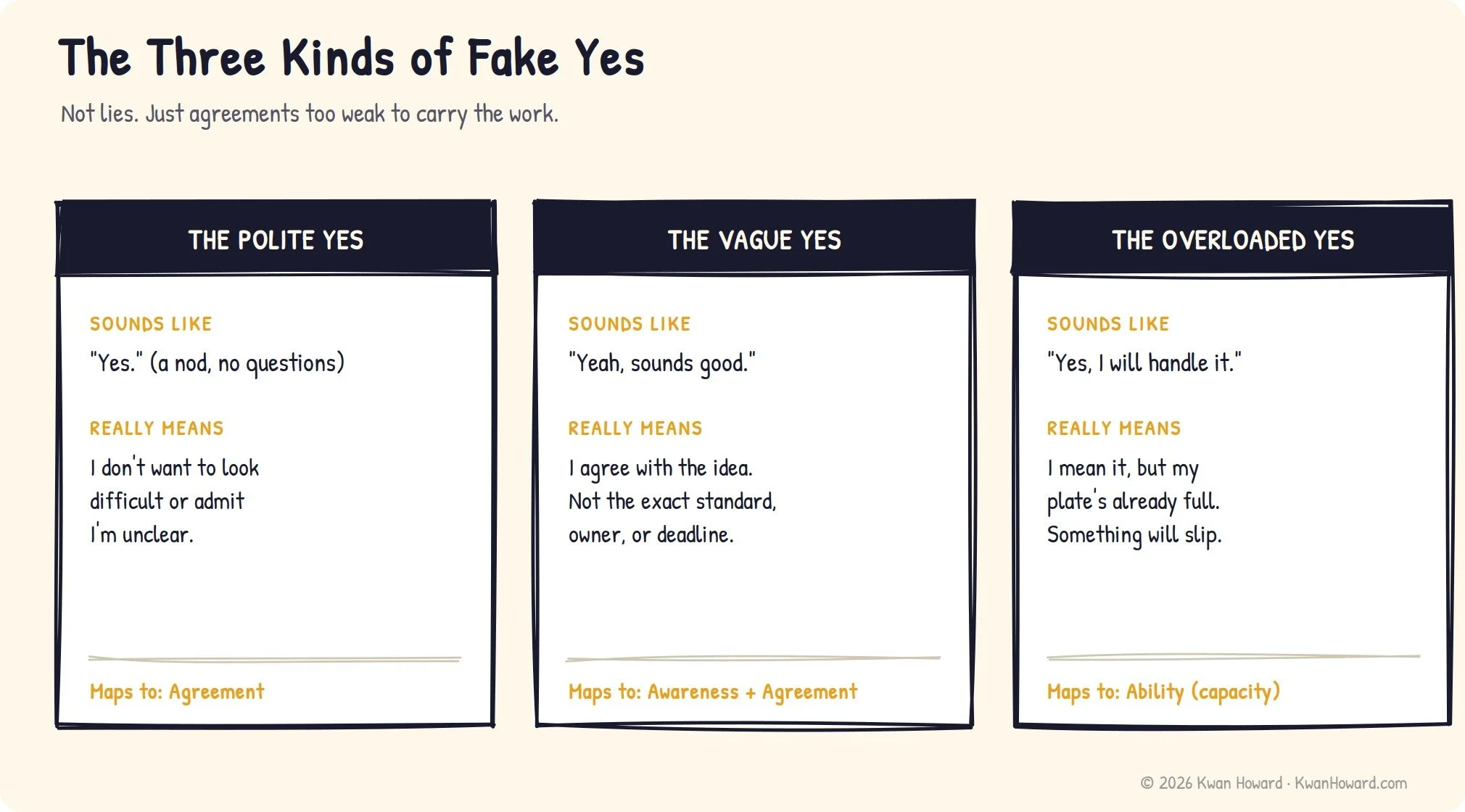
Diagram of the three kinds of fake yes — polite, vague, and overloaded — and which accountability breakdown each one maps to." Caption: "The Three Kinds of Fake Yes. Not lies. Just agreements too weak to carry the work. Each one points to a different breakdown — Awareness, Ability, or Agreement.
There are three common kinds of fake yes.
Not fake because the person's lying. Fake because the agreement isn't strong enough to carry the work.
1. The Polite Yes
The polite yes shows up when the person doesn't want to push back on you.
They say yes because you're the boss.
They don't want to look difficult. They don't want to ask a "dumb" question. They don't want to admit they're unclear. They don't want to say they're already buried.
So they nod.
You walk away thinking you've got agreement.
They walk away hoping they can figure it out later.
That's dangerous, because the polite yes creates quiet failure. Nobody argues. Nobody pushes back. Nobody raises a hand. Then the work slips.
2. The Vague Yes
The vague yes shows up when the person agrees with the general idea but not the specific outcome.
They agree the task matters.
They agree somebody should do it.
They agree it should happen soon.
But they're not clear on the exact standard, the deadline, the owner, or the first step.
This is where you hear:
"I thought you meant..."
"I didn't know you wanted it done that way."
"I thought somebody else was handling that part."
"I didn't realize you needed it by then."
The vague yes is usually an Awareness or Agreement problem. The person didn't have a clear enough picture of the work, or a clear enough commitment to own it.
3. The Overloaded Yes
The overloaded yes shows up when the person agrees, but their plate's already full.
They might mean to follow through. But they're buried. Too many priorities, no clear cutline, not enough hours.
So they say yes in the moment, then reality takes over.
That's usually an Ability problem. Not ability as in talent. Ability as in capacity.
If somebody's got ten priorities and no clear cutline, saying yes to number eleven doesn't create ownership. It creates a hidden trade-off. Something's going to slip. The only question is whether you find out before or after the deadline.
What Managers Should Do Instead
Stop asking for a soft yes.
Start closing the loop.
A strong close doesn't have to be complicated. You need five things clear:
Who owns it. What done looks like. When it's due. What the first step is. When they should raise a blocker.
That turns agreement into something real.
Instead of asking:
"Can you handle this?"
Say:
"Let's make sure we're leaving with the same understanding. You own this. Done means the report's updated, reviewed, and sent to the team by Friday at 2 p.m. Your first step is to confirm the numbers with Alex today. If Alex doesn't get back to you by tomorrow at noon, I need you to flag it before the deadline's at risk."
That's not micromanaging. That's a clean handoff.
The Follow-Through Reset Script
When somebody says yes and doesn't follow through, don't open with an accusation.
Open with diagnosis.
Use this:
"Last time we talked, I walked away thinking this was agreed to, but it didn't get done. Before I call this an accountability issue, I want to understand what broke. Was the expectation unclear, was something blocking you, or did we not have a real commitment?"
That script does three things. It names the gap. It keeps you from jumping straight to blame. And it forces the conversation into Awareness, Ability, or Agreement.
Now you're not just venting. You're diagnosing.
If it was Awareness
If the person didn't understand the expectation, clarify the standard.
Say:
"Here's what I meant by done."
Then spell out the outcome in plain language.
Don't say:
"You should've known."
That might feel good, but it doesn't fix the transfer problem.
Say:
"Going forward, when I ask for this, the standard is this."
Then have them say the expectation back in their own words. Not as a test. As a transfer check.
If it was Ability
If the person understood the expectation but couldn't do it, find the blocker.
Ask:
"What got in the way?"
Then listen for specifics. Was it time? Training? Access? Authority? Too many priorities? A broken process? Somebody else they were waiting on?
Don't take a vague answer like "I got busy."
Ask:
"What specifically took priority over this?"
That gets you to the real trade-off. Then you decide whether it's a real support gap or weak ownership.
If it was Agreement
If the person understood the work and could do it but never really committed, reset the close.
Say:
"Next time, I need us to leave with clear ownership. If you can't own it, say so in the conversation. But once we agree, I expect the work to move, or the blocker to get raised before the deadline."
That's where accountability starts to be fair. Because now you're not punishing confusion. You're dealing with a broken commitment.
The Manager's Mistake: Taking Silence as Agreement
One of the biggest mistakes managers make is treating silence as a yes.
Nobody objected, so you figure everybody's on board.
But silence can mean anything. Confusion. Disagreement. Fear. Overload. Somebody who checked out three minutes ago.
A better question is:
"What could get in the way of this?"
That gives people room to raise problems before they turn into missed deadlines.
Another good one:
"Is there anything about this that feels unrealistic?"
That doesn't weaken accountability. It strengthens it. Because once the concern's out in the open, you can deal with it.
Don't Chase Work You Never Closed
If you didn't close the work, expect to chase it.
That might sound harsh, but it's true.
A lot of managers spend their whole week following up on work that was never really handed off in the first place.
They're not managing performance. They're managing ambiguity.
The cleaner the close, the less chasing you do.
The Simple Rule
Don't leave important work with a casual yes.
Leave with a receipt.
A receipt means both sides can answer:
Who owns this? What does done look like? When's it due? What's the first step? When do we raise a blocker?
If you can't answer those, you don't have agreement yet. You have hope.
And hope isn't a management system.
Final Thought
When your team says yes but doesn't follow through, don't assume the yes was real.
Test it.
Clarify it.
Close it.
Then hold people to it.
That's the order.
Awareness first. Ability second. Agreement third. Accountability after that.
Skip those steps and you'll keep having the same conversation with different tasks.
Frequently Asked Questions
Why does my team say yes but not follow through?
Your team might be saying yes without making a real commitment.
Sometimes yes means they heard you. Sometimes it means they want the conversation to end. Sometimes it means they agree in general but don't understand the specific outcome.
Before you assume it's an accountability issue, check whether the breakdown's in Awareness, Ability, or Agreement.
Is this an accountability problem?
It might be, but not automatically.
If the person didn't understand what good looked like, it's an Awareness problem.
If they couldn't realistically do it with the time, tools, training, or authority they had, it's an Ability problem.
If they never truly agreed to own the outcome, it's an Agreement problem.
It becomes a true accountability problem when all three were in place and the person still didn't follow through.
What should I say when someone says yes but misses the deadline?
Say this:
"Last time we talked, I walked away thinking this was agreed to, but it didn't get done. Before I call this an accountability issue, I want to understand what broke. Was the expectation unclear, was something blocking you, or did we not have a real commitment?"
That keeps it direct without starting with blame.
How do I know if someone really agreed?
A real agreement covers five things:
Who owns it. What done looks like. When it's due. What the first step is. When they should raise a blocker.
If those five aren't clear, you probably don't have real agreement yet. You have a loose conversation.
How do I stop chasing my team after they agree to do something?
Stop taking a casual yes for an answer.
Before the conversation ends, close the loop. Ask:
"What are you owning?" "What does done look like?" "When will this be done?" "What's your first step?" "What should you do if something blocks you?"
The goal isn't to babysit the work. It's to make ownership clear enough that you don't have to keep chasing it.
What if they keep missing commitments after everything's clear?
If the expectation was clear, they could do the work, and they clearly agreed to own it, then the conversation changes.
Now you're dealing with accountability.
At that point you name the pattern, explain the impact, reset the expectation, and spell out what changes if it keeps happening.
But don't start there until you know the foundation was actually in place.
Your Next Step
Before you remind your team again, find out why the follow-through's breaking down.
Is it Awareness?
Is it Ability?
Is it Agreement?
Take the free diagnostic here: kwanhoward.com/accountability-diagnostic
Because if you misread the breakdown, you fix the wrong problem.
Tired of saying the same thing twice? Find out what's actually breaking down on your team.
Most of what gets blamed on your team — phones out, missed standards, low ownership, the conversations you have to keep repeating — isn't a people problem. It's a foundation problem. The Foundation-First Accountability Diagnostic identifies what's actually breaking down on your team in 5 minutes — and tells you what to fix first.
