
Stop Doing Your Team’s Work: Why They Aren’t Following Through and What to Fix First
If you're doing your team's work, you don't just have a workload problem.
You have a transfer problem.
Somewhere between what you expected, what they understood, what they could actually do, and what they really agreed to own, the work bounced back to you.
Now you're carrying it.
You're fixing mistakes. You're chasing updates. You're redoing tasks. You're answering questions they should be able to answer. You're stepping in because "it's faster if I just do it myself."
That might solve today's problem.
But it builds tomorrow's trap.
Because every time you quietly take the work back, you teach the team that ownership is optional.
Not because you're weak.
Not because they're lazy.
But because the pattern is now clear to everybody:
When the work gets messy, unclear, uncomfortable, or late, you'll catch it.
That's how a manager becomes the backup plan for their own team.
The Real Problem Isn't Always Accountability
Most managers call this an accountability problem too early.
They say:
"My team doesn't follow through."
"They don't take ownership."
"They wait for me to tell them everything."
"They say yes, but nothing happens."
"They only move when I push."
Sometimes that's true.
But a lot of follow-through problems aren't accountability problems. Not yet.
They're pre-accountability problems.
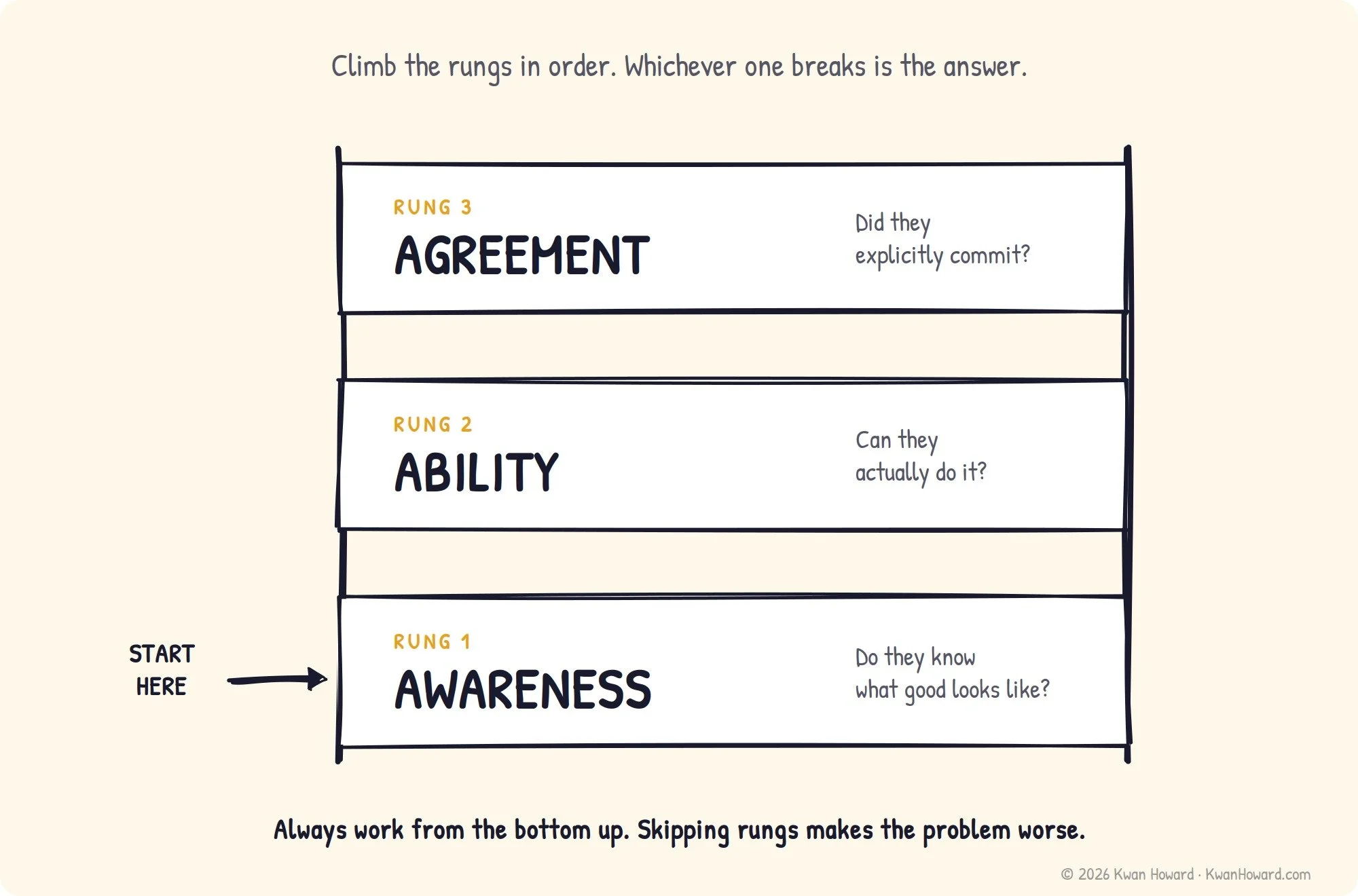
Before you can hold someone accountable, three things have to be true:
They have to know what good looks like. They have to be able to do the work. They have to actually agree to own it.
If one of those is missing, you're not dealing with clean accountability yet.
You're dealing with a crack in the foundation.
And that crack almost always sits in one of three places:
Awareness. Ability. Agreement.
Before You Have Another Accountability Conversation
Most managers jump straight to pressure.
They remind. They repeat. They follow up again. They threaten consequences. They take the work back.
But pressure doesn't fix the wrong breakdown.
Before you have another accountability conversation, find out which part of the foundation is actually failing.
Take the free 5-minute diagnostic here: kwanhoward.com/accountability-diagnostic
It'll show you whether your team's follow-through is breaking down in Awareness, Ability, or Agreement.
Once you know that, you stop guessing.
Now let's break down what each one looks like.
Breakdown 1: Awareness
Awareness means the person actually understands the expectation.
Not vaguely.
Not generally.
Not "they should know."
Actually understands it.
This is where a lot of managers get caught.
You think you were clear because you said the words.
But the team heard something different.
You said:
"Make sure the shift is ready."
They heard:
"Do the normal prep."
You meant:
"Labor's tight, the lobby needs to be clean before rush, the headsets need to be checked, the new person needs a station plan, and I want no surprise gaps before 11:30."
That's not the same instruction.
You said:
"Follow up with the customer."
They heard:
"Send a message."
You meant:
"Call them, confirm the issue's fixed, write down the outcome, and tell me if they're still upset."
Again. Not the same instruction.
This is how managers end up doing the team's work.
Not because the team refused.
Because the picture in your head never made it into their head.
Awareness warning signs. You've probably got an Awareness breakdown if you hear:
"I thought you meant..."
"I didn't know you wanted it done that way."
"Nobody told me that part."
"I figured this was good enough."
"I didn't realize that was the priority."
When Awareness is broken, more pressure won't fix it. You need a clearer standard.
Breakdown 2: Ability
Ability means the person can realistically do the work with the skill, time, tools, staffing, authority, and support they've got.
This is the part managers skip, because it feels like excuse-making.
It's not excuse-making.
It's diagnosis.
Sometimes the person knows exactly what you want and still can't execute.
Maybe they were never trained.
Maybe they don't have access.
Maybe the process is clunky.
Maybe they don't have enough people on the floor.
Maybe the standard takes judgment they haven't built yet.
Maybe they're trying, but the system around them is broken.
If you hold someone accountable for work they aren't set up to do, you don't create ownership.
You create avoidance.
They stop raising their hand. They hide the problem. They wait for you to bail them out. They go quiet, because every attempt feels like a failure.
Then you step in and say:
"Why do I have to do everything myself?"
But the real question is:
"Did I check they could own this before I handed it off?"
Ability warning signs. You've probably got an Ability breakdown if you hear:
"I tried, but I got stuck."
"I don't know how to handle that one."
"I didn't have access."
"We were short."
"I was waiting on somebody else."
"I didn't know what to do when that happened."
When Ability is broken, a lecture won't fix it. You need training, tools, decision rights, or a simpler process.
Breakdown 3: Agreement
Agreement means the person actually committed to owning the work.
This is where it gets uncomfortable.
Because sometimes the team understands the expectation.
Sometimes they've got the ability.
But they still never really agreed.
They nodded.
They said "okay."
They acted like they were on board.
But there was no real commitment.
That's an Agreement breakdown.
Agreement isn't the same as hearing you.
Agreement isn't the same as being in the meeting.
Agreement isn't the same as staying quiet.
Agreement means there's a clear owner, a clear outcome, a clear deadline, and a clear first step.
Without that, work floats.
And when work floats, it floats right back to the manager.
Agreement warning signs. You've probably got an Agreement breakdown if you hear:
"I thought somebody else was doing that."
"I didn't know I owned it."
"I was going to get to it."
"I didn't think it was that urgent."
"I didn't agree to that deadline."
"I thought we were still talking it through."
When Agreement is broken, repeating yourself won't fix it. You need a clear commitment.
Why Managers Keep Taking the Work Back
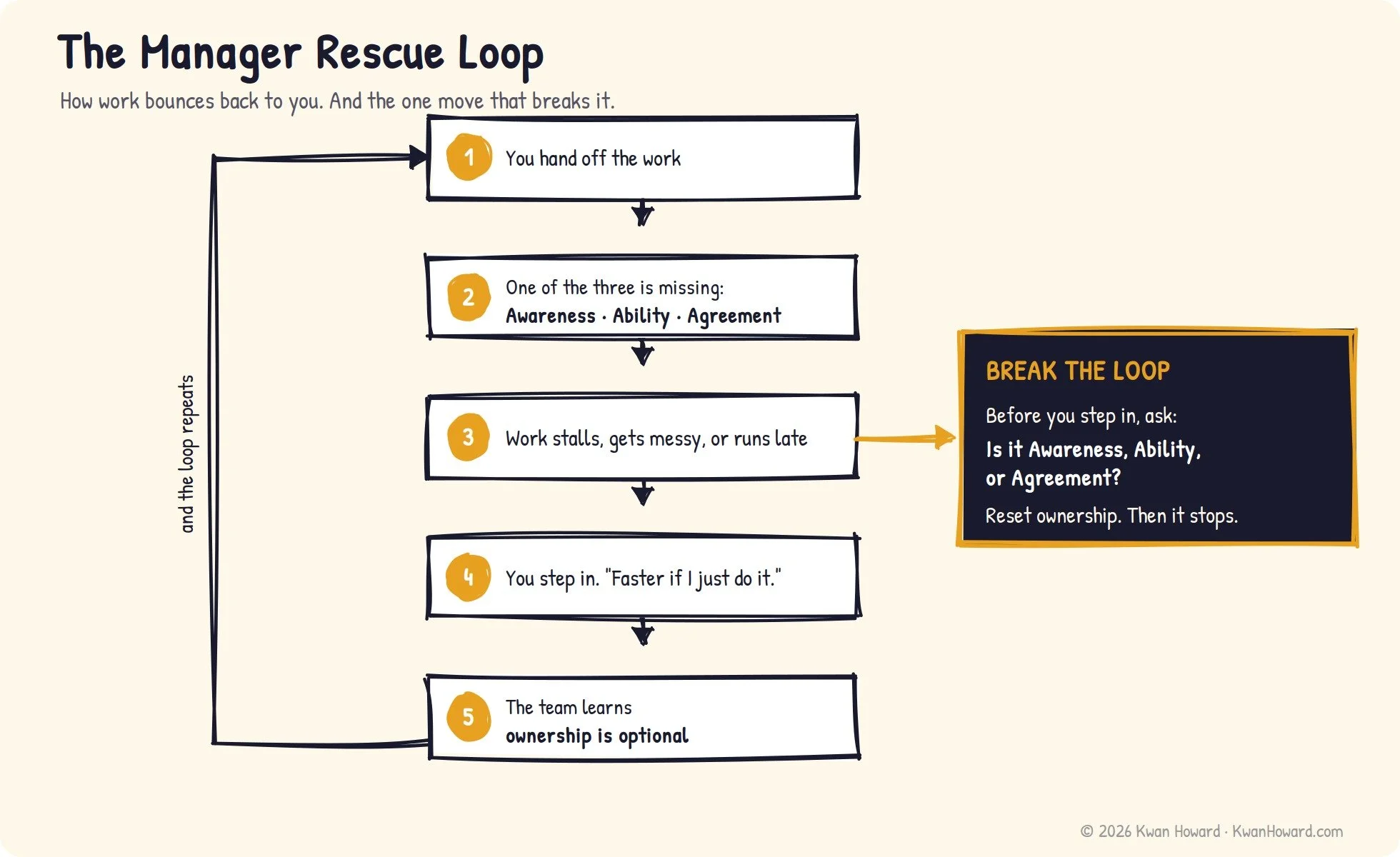
Every time you quietly take the work back, you teach the team that ownership is optional. Diagnose the breakdown before you step in, and the loop stops.
Most managers don't take work back because they enjoy it.
They take it back because the pressure is real.
The customer's waiting. The boss wants an update. The deadline's close. The shift's falling apart. The team's moving too slow. The mistake's out in the open. The outcome matters.
So the manager steps in.
In the moment, it feels responsible.
Long term, it builds dependency.
The team learns:
"If I wait long enough, the manager will do it."
"If I make it messy enough, the manager will take over."
"If I ask enough questions, the manager will think for me."
"If I blow the deadline, the manager will clean it up."
It's not always on purpose.
But it becomes the pattern.
And once the pattern sets, the manager becomes the system.
That's the dangerous part.
Because now the operation only runs when you absorb the gaps.
How to Stop Doing Your Team's Work
The answer isn't to abandon the team.
The answer is to stop rescuing without diagnosing.
Before you jump in, ask one question:
What's actually broken here. Awareness, Ability, or Agreement?
That question changes the whole conversation.
Because each breakdown needs a different response.
If Awareness is broken, clarify the standard.
Don't say:
"I need you to do better."
Say:
"Let me clarify what good looks like."
Then spell out the outcome. For example:
"When I say the shift needs to be ready, I mean three things. Stations stocked. Labor assigned. The first rush plan confirmed before 11:30. If one of those is missing, the shift isn't ready."
That's clearer.
You're not just handing out a task. You're defining the standard.
A simple Awareness script:
"Before we call this a follow-through issue, I want to make sure I was clear. Here's what I expected. Here's what the finished result should look like. And here's where the gap showed up."
That keeps it clean. It keeps you from treating confusion like defiance.
If Ability is broken, fix the support gap.
Don't say:
"You need to figure it out."
Say:
"What blocked you from finishing it?"
Then listen for the real one.
Was it skill? Time? Tools? Staffing? Authority? Too many priorities at once? A broken process?
If the person's missing something real, fix that first.
A simple Ability script:
"I want you to own this, but I need to know if anything's blocking you. Is this a training thing, a resource thing, a time thing, or a decision thing?"
That forces the talk out of vague excuses and into the specific thing that's in the way.
Then you decide what support is fair.
But support doesn't mean taking the work back.
Support might mean:
"I'll show you once."
"I'll clear this blocker."
"I'll give you the decision rule."
"I'll help you prioritize."
"I'll check progress at 2 p.m., but you still own the outcome."
That's the line between support and rescue.
If Agreement is broken, lock in the commitment.
Don't leave ownership implied. Make it plain.
A simple Agreement script:
"Let's make sure we're clear before we walk away. You own the task. The outcome is this. The deadline is this. Your first step is this. If something blocks you, I expect you to raise it by this time, not after the deadline's blown."
That might feel basic.
But basic is what kills mystery work.
A lot of managers lose the thread because they leave the conversation without a clean close. They assume ownership was understood. Then later, everybody's got a different version of what got agreed to.
That's where the manager gets dragged back in.
The fix is a decision receipt.
A decision receipt names:
Who owns it. What done looks like. When it's due. What the first step is. When they should raise a blocker.
That's not micromanaging.
That's just keeping the operation clean.
Diagnose It Before You Repeat Yourself Again
If your team keeps nodding, agreeing, and still not following through, don't start by saying it louder.
Start by diagnosing the breakdown.
Is it Awareness? They don't really understand what good looks like.
Is it Ability? They can't realistically do it with what they've got.
Is it Agreement? They never truly committed to owning it.
That's the difference between fixing the problem and chasing the symptom.
Take the free diagnostic here: kwanhoward.com/accountability-diagnostic
In 5 minutes you'll see which part of the foundation is most likely breaking down with your team.
Stop Rescuing in Silence
The worst version of doing your team's work is doing it quietly.
You fix the mistake.
You stay late.
You finish the task.
You clean up the mess.
Then you carry resentment because nobody saw what you had to absorb.
That's a bad trade.
If you've got to step in, name it.
Say:
"I'm stepping in today because the deadline can't move. But after this, we're going to look at why it came back to me, and what's got to change so you own it next time."
That one sentence matters.
It keeps the rescue from going invisible.
You're not punishing anybody. You're making the pattern visible.
The Manager's Rule: Don't Take Back Work Without Resetting Ownership
Sometimes you'll have to help.
Sometimes you'll have to jump in.
Sometimes the customer, the deadline, or the business forces your hand.
Fine.
But don't take the work back without resetting ownership.
Use this rule:
If I rescue the result, I still reset the system.
That means once the fire's out, you go back and ask:
"What broke?"
Was it Awareness? Was it Ability? Was it Agreement?
Then you fix the actual breakdown.
Otherwise the same problem shows up next week wearing a different outfit.
What This Looks Like on the Floor
Say you ask a supervisor to get the team ready for a busy lunch.
Lunch goes bad.
Stations aren't stocked. The new employee's lost. The drive-thru backs up. You jump in and start directing traffic.
The old response is:
"Why do I have to do everything myself?"
The better response is:
"Let's figure out what broke."
Awareness:
"Did you know what I meant by shift-ready?"
Ability:
"Did you know how to build the station plan and set up the new employee?"
Agreement:
"Did you understand you owned lunch readiness before 11:30?"
Each answer points to a different fix.
If they didn't understand the standard, clarify it.
If they didn't have the skill, train it.
If they never took ownership, reset the commitment.
But don't just say:
"You need to be more accountable."
That's too vague.
Vague accountability gives you repeat problems. Specific diagnosis gives you ownership.
The Goal Isn't to Do Less Work
The goal isn't to dodge work.
The goal is to stop doing the wrong work.
Your job as a manager isn't to catch every dropped ball.
Your job is to build a team that carries the right work without you catching it every time.
That takes standards.
It takes training.
It takes clear commitments.
It takes follow-up.
And it takes consequences when somebody had Awareness, Ability, and Agreement and still didn't follow through.
That's when accountability is the right tool.
But if you skip the diagnosis and jump straight to accountability, you might punish the wrong problem.
And when you fix the wrong problem, the work keeps coming back to you.
Final Thought
If you're doing your team's work, stop before you blame effort, attitude, or ownership.
Ask:
Did they know what good looked like?
Could they actually do it?
Did they clearly agree to own it?
That's the foundation.
Awareness. Ability. Agreement.
Fix that first.
Then accountability finally has something solid to stand on.
Frequently Asked Questions
Why do I keep doing my team's work?
You usually keep doing your team's work because the work was never fully transferred.
Somewhere in the handoff, one of three things broke:
They didn't clearly understand what good looked like. They didn't have the ability, tools, time, training, or authority to do it. They never truly agreed to own the outcome.
That's why the work keeps bouncing back to you.
Before you assume your team has an accountability problem, find out whether the real issue is Awareness, Ability, or Agreement.
How do I stop doing work my employees should do?
Start by refusing to rescue the work without resetting ownership.
That doesn't mean you abandon the team. It means you stop quietly absorbing the gap.
Next time work comes back to you, stop and ask:
Did they understand the expectation? Could they actually do the work? Did they clearly agree to own it?
If the answer's no, fix that breakdown first. If the answer's yes, then you can have a real accountability conversation.
The goal isn't to do less work. The goal is to stop doing the wrong work.
Is doing my team's work a delegation problem or an accountability problem?
It depends.
If the person didn't understand the standard, it's an Awareness problem.
If the person couldn't realistically do it, it's an Ability problem.
If the person never clearly committed, it's an Agreement problem.
If all three were in place and they still didn't follow through, then you're probably dealing with a true accountability problem.
That's why managers get stuck. They call everything accountability too early, then reach for the wrong fix.
How do I get my team to take ownership?
Ownership starts with a clear transfer.
Don't leave the conversation with vague agreement.
Make five things clear:
Who owns it. What done looks like. When it's due. What the first step is. When they should raise a blocker.
That's not micromanaging. It's how you prevent mystery work.
When ownership's vague, work drifts. And when work drifts, it comes back to the manager.
What should I do when employees don't follow through?
Don't start by saying it louder.
Start by diagnosing the breakdown.
Ask:
Was the expectation clear? Could the person do the work with what they had? Was there a real commitment?
If it's Awareness, clarify the standard. If it's Ability, fix the support gap. If it's Agreement, reset the commitment.
If all three were there and the person still didn't follow through, now the conversation changes. Now you're dealing with accountability.
How do I know which breakdown is happening with my team?
Fastest way is to run the issue through the three-part filter:
Awareness: Did they know what good looked like? Ability: Could they actually do it? Agreement: Did they clearly agree to own it?
Most managers skip this step and go straight to reminders, pressure, or consequences. That's how they end up fixing the wrong problem.
Your Next Step
Before you have another conversation about follow-through, take 5 minutes and find out where the breakdown is actually happening.
Because if you misread the breakdown, you fix the wrong problem.
Start here: kwanhoward.com/accountability-diagnostic
Tired of saying the same thing twice? Find out what's actually breaking down on your team.
Most of what gets blamed on your team — phones out, missed standards, low ownership, the conversations you have to keep repeating — isn't a people problem. It's a foundation problem. The Foundation-First Accountability Diagnostic identifies what's actually breaking down on your team in 5 minutes — and tells you what to fix first.
